


When I worked at Applied Materials we hired a management consultant named Dr. Ichak Adizes. The author of nearly 30 books, Adizes is an original, full of insights on organizational development and lifecycles.
His best-known program is called the PAEI Management Model. Adizes categorizes managers as filling one of four roles, Producer, Administrator, Entrepreneur and/or Integrator. While some people can handle more than one function, a single person can’t handle all the elements of the job. You need an administrative component, an entrepreneurial contribution, an integrator to make things work together, and you need producers — people who are focused on getting the job done. As Adizes explains it:
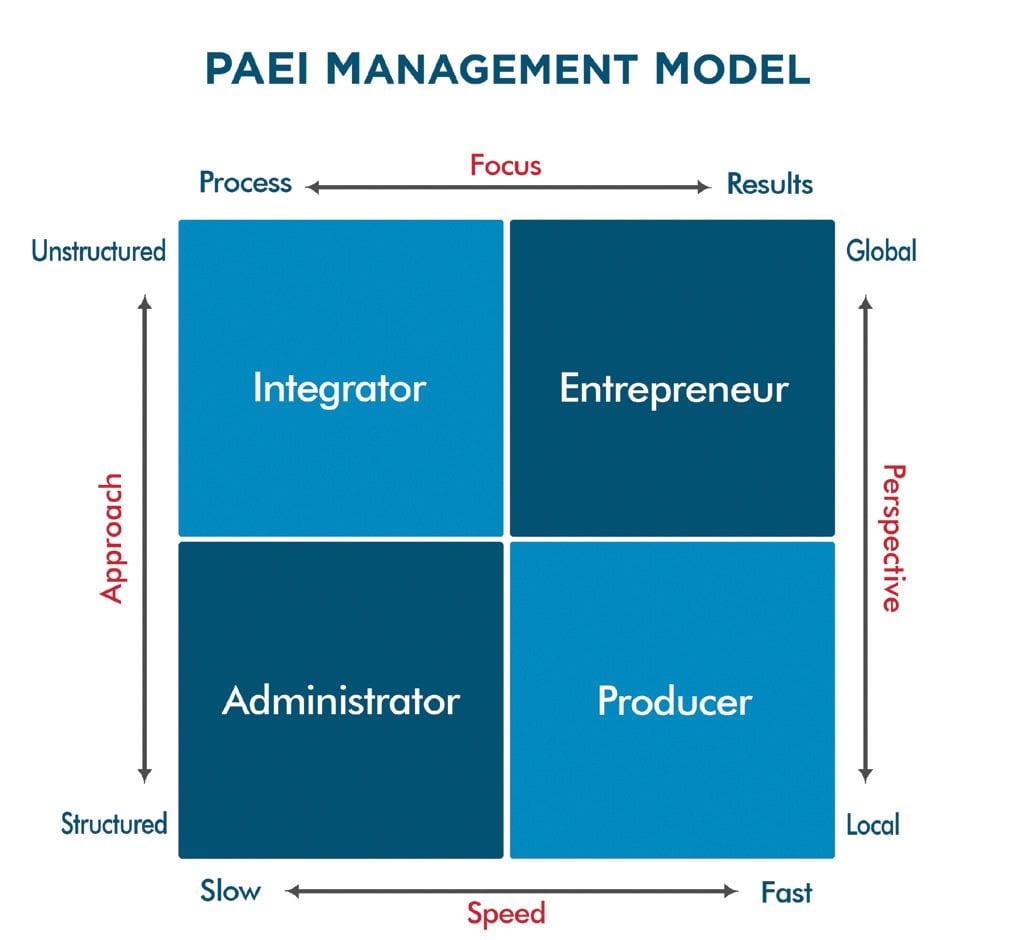
Producer (P): Producers focus on results. They are doers — the ones who bring energy, output, and execution. Their challenge can be in knowing when to slow down and reflect.
Producers are essential to every nonprofit. They’re the development director who consistently hits fundraising targets, the program manager who ensures every client receives services on time, the volunteer coordinator who fills every shift. They embody “book it and ship it” — because success is 90 percent implementation.
I think of the staff at a food bank who, during the early days of the pandemic, didn’t wait for perfect information. They adapted distribution models on the fly, moving from indoor pantries to drive-through pickup in a matter of days. Producers understand that organizations in motion can alter course much faster than those stuck in place. They know that given the choice between waiting and riding momentum, momentum wins every time.
Administrator (A): Administrators bring structure. They design processes, optimize systems, and manage policies for consistency and predictability. However, over-systematizing can lead to rigidity.
To do “the whole job,” every nonprofit needs strong Administrators. They’re the finance director who ensures every dollar is accounted for and builds the cash reserves to cover three to six months of operating costs. They’re the HR manager who creates equitable compensation structures and clear personnel policies. They’re the operations lead who designs grant reporting systems that satisfy funders without overwhelming program staff.
The challenge for Administrators is knowing when structure serves the mission and when it becomes an obstacle. I’ve seen nonprofits where the policies manual grows thicker every year while the organization’s ability to respond quickly to community needs shrinks. The best Administrators build systems that create consistency without rigidity — guardrails, not straitjackets.
Entrepreneur (E): The visionary. Entrepreneurs drive innovation, initiate change, and take risks. But they must avoid chasing shiny distractions.
Entrepreneurs have what I call “court sense.” Like a basketball player who sees the whole floor, they perceive driving forces before others do — demographic shifts, changes in government funding, emerging community needs. They position the organization to capitalize on opportunity.
When our family helped found The Northern Sierra Partnership, it took entrepreneurial thinking to imagine what five independent conservation nonprofits might accomplish together that none could do alone. That vision has led to preserving over 100,000 acres in the California Sierra Nevada Mountains.
Entrepreneurs need to “face the elevator door.” They prepare the organization so that when momentum shifts — when a major donor expresses new interest, when a policy window opens, when a community crisis creates urgent need —everyone is ready to step forward.
Integrator (I): Integrators provide the glue. They foster collaboration, mutual trust and respect, and shared purpose.
Integrators build culture — and culture, as I like to say, eats strategy for breakfast. They’re the executive director who makes time for walking meetings and sack lunches with staff at every level, “porpoising” through the organization to understand what’s really happening. They’re the board chair who ensures that bad news is welcomed, not punished, because bad news is good news if you do something about it.
Integrators create the conditions where people feel respected and trusted. They pay attention to employees’ health, workplace comfort, and psychological safety. They model a collaborative mindset, treating their partners’ success as equal to their own. When tensions arise — as they inevitably do in mission-driven work — Integrators help teams stay focused on the “inspirational why,” the reason the organization exists.
Perhaps most importantly, Integrators help to set the “tone at the top.” When board members treat each other and management with courtesy and respect, staff notice. When leaders share credit generously and accept responsibility for failures, a culture of accountability follows. Integrators understand that you can’t change culture just by announcing that it needs to change. You have to model the behaviors you want to see — consistently, over time.
Managers can be strong in two or even three roles, but unless one of those roles is (I)ntegrating, they will not become leaders. You can be a brilliant Producer, a meticulous Administrator, or a visionary Entrepreneur. But without the ability to bring people together around shared purpose, you’ll never build something that lasts.
Look around your organization. Who are your Producers, the ones who get things done? Who brings Administrative discipline? Who supplies the Entrepreneurial vision? And who Integrates it all —building a culture of trust and respect that makes everything else possible?
The answers will tell you a great deal about your organization’s strengths. The gaps will tell you where to focus next.